
Coraline and the Horror of False Perfection
Explore the Other Mother, button-eye symbolism, false perfection, and the darker meaning of Neil Gaiman's Coraline.
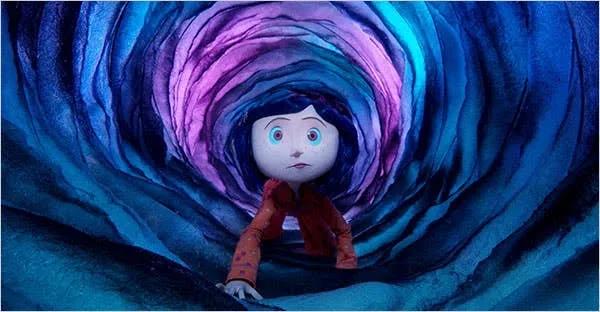
In Neil Gaiman’s Coraline, a young girl discovers a small door in her family’s new home that leads to a world almost identical to her own. At first, the differences seem entirely to her advantage. The food tastes better, the garden is more beautiful, and the people around her appear far more interested in what she has to say. Most importantly, her Other Mother seems to offer the kind of attention Coraline has been missing from her real parents. For a child who feels overlooked, this new world looks less like a threat than a second chance at happiness.
That is what makes the** Other World **so unsettling. It does not tempt Coraline with something she has no reason to want. It takes the small disappointments of her ordinary life and offers to correct them. Her parents are busy, her surroundings are dull, and she has little control over her circumstances. The Other World promises to fix all of this, turning her dissatisfaction into an opportunity to draw her deeper into its grasp.
Yet the more closely Coraline examines this seemingly perfect place, the more its generosity begins to resemble a form of manipulation. Beneath its colourful surfaces lies a disturbing question: what happens when everything we want is offered to us on the condition that we give up the freedom to choose for ourselves?
The Other World Knows Exactly What Coraline Wants
Coraline's boredom is not simply a convenient excuse for her adventure. It shapes the way she sees the world around her. Her parents are preoccupied with their work, the weather is unpleasant, and the adults she encounters often have their own concerns. None of this makes her life particularly terrible, but it leaves her feeling as though she has to find her own entertainment and make herself noticed.
The Other World understands this frustration remarkably well. Its food is more appealing, its garden is arranged around Coraline's image, and even the neighbours become more entertaining versions of themselves. Everything seems to suggest that someone has finally paid attention to the things she likes. Unlike her real surroundings, where she has to adapt to other people's schedules and limitations, this place appears to have been created with her in mind.
There is something important about that distinction. Coraline is not merely attracted to a more beautiful house. She is attracted to the possibility of being the centre of someone's attention. **The Other Mother'**s apparent devotion answers a genuine emotional need, which is precisely why it is so difficult to recognise as dangerous. Her affection does not initially look like a threat because it resembles the kind of care Coraline has been wanting.
But there is a difference between being understood and being studied. The Other Mother knows what Coraline wants, yet this knowledge does not lead to a relationship in which both of them can exist as independent individuals. Instead, she uses Coraline's desires to construct an environment in which resistance becomes increasingly difficult. Every pleasant surprise serves a purpose; every act of generosity makes the offer of staying a little more tempting.
The Other World, then, represents more than an escape from boredom. It reflects the danger of getting exactly what we want from someone who has no intention of allowing us to want anything else.
Button Eyes and the Price of Being Loved
The button eyes are among the most disturbing images in Coraline, partly because they transform something ordinary into something deeply unnatural. Buttons belong to clothing, toys, and handmade objects. They can be decorative, even charming. Placed where a person's eyes should be, however, they turn the familiar human face into something artificial.
The Other Mother's demand that Coraline have buttons sewn over her eyes reveals the condition that has been hiding beneath her affection all along. Coraline can remain in this world, but only if she allows herself to be changed into something the Other Mother can keep. Eyes are especially significant here because seeing is closely connected to understanding. Coraline's ability to look at the world, notice inconsistencies, and question what she encounters allows her to recognise that the Other Mother's apparent kindness does not tell the whole story. The buttons would replace that independent perspective with a fixed, manufactured appearance. Coraline would still look like herself in some superficial sense, but she would no longer be free to see or understand the world on her own terms.
The demand also changes the meaning of the Other Mother's supposed love. At first, she seems willing to give Coraline everything. Eventually, it becomes clear that she expects something in return: not simply gratitude or obedience, but possession. She does not want Coraline to grow, change, become bored, or decide that she would rather leave. She wants to preserve her as a permanent part of an artificial family.
This is where the story's horror becomes more complicated than the presence of a sinister creature. The Other Mother offers Coraline a version of love without the uncertainty that comes with another person's independence. There will be no competing priorities, no disappointing meals, no distracted conversations. But there will also be no meaningful choice. Her affection is inseparable from the desire to control the person receiving it.
The buttons make that contradiction visible. What initially looks like an invitation to belong becomes a demand to surrender one's individuality. Coraline is not being asked to become part of a family; she is being asked to become an object that belongs to someone else.
Why the Perfect World Becomes a Horror Story
For much of her time in the Other World, Coraline encounters familiar things that have been altered just enough to seem better. This makes the eventual transformation of the environment particularly effective. When she refuses the Other Mother's offer, the world begins to lose its appeal. The colourful spectacle gives way to emptiness, confinement, and decay. The house that once seemed inviting becomes a place from which Coraline must escape.
The change reveals something that was difficult to notice while Coraline was enjoying herself: the beauty of the Other World was never independent of its purpose. Its garden, food, performances, and apparent comforts were part of an elaborate attempt to attract and retain her. Once she refuses to play the role intended for her, the world has little reason to maintain the illusion.
**The Other Mother'**s changing appearance follows the same logic. Her affectionate manner initially makes her seem like an ideal parent, but that image depends on Coraline's willingness to accept what is being offered. When Coraline resists, the warmth gives way to anger and predatory behaviour. The apparent transformation is frightening, but it also forces us to reconsider what came before it. The Other Mother has not suddenly become controlling. Her earlier kindness was always connected to the outcome she wanted.
The Other World therefore resembles a trap whose most effective feature is that it does not look like one. Coraline is not dragged into it against her will. She enters because she is curious, stays because she enjoys herself, and initially has reasons to believe that she has found something better than what she left behind. The danger develops through attraction rather than immediate force. This is also what makes the story's treatment of temptation so effective. Coraline's desires are not foolish or shameful. Wanting attention, excitement, and affection is entirely understandable. The problem lies in the Other Mother's attempt to turn those desires into a means of control. The world becomes horrifying when Coraline realises that its comforts have been designed to make leaving feel like a loss, even when staying would mean losing herself.
Coraline's Real World Is Not Perfect, and That Matters
It would be easy to read Coraline as a story about learning to appreciate what one already has. However, this interpretation risks overlooking the fact that Coraline's frustrations are real. Her parents are often distracted, and their attempts to care for her do not always meet her expectations. The story does not need to pretend that her ordinary life is ideal in order to show why the Other World is dangerous.
In fact, the contrast between the two worlds is more interesting because Coraline's real parents are not perfect. They cannot offer constant attention or arrange their lives around her wishes. Their relationship with her exists within the limitations of ordinary life, where people have responsibilities, misunderstandings occur, and affection does not always arrive at the right moment.
The Other Mother appears to solve these problems by removing the limitations themselves. Yet her solution depends on eliminating the very independence that makes a relationship meaningful. Coraline can have everything she wants only if she accepts that someone else will decide what she needs, where she belongs, and who she is allowed to become.
Her real world offers no such guarantee of happiness, but it leaves room for her to act. She can explore, make mistakes, question adults, and disagree with the people around her. Even her dissatisfaction gives her a degree of freedom: she can recognise that something is missing from her life without having to accept the first person who promises to provide it. Coraline's decision to return home does not mean that she suddenly stops wanting attention or that her parents become more attentive overnight. Rather, she learns to recognise the difference between an imperfect relationship and one that only appears perfect because it allows no room for refusal. That distinction gives her choice its emotional weight. Coraline does not escape because she discovers that the Other World has nothing to offer. She escapes because she understands what it expects her to give up in exchange.
The Real Horror of the Other World
The Other World in Coraline is frightening because it turns ordinary desires into a means of entrapment. Its promise of a better life is convincing precisely because Coraline has genuine reasons to want one. The story takes the familiar fantasy of being understood completely, of having every need anticipated and every disappointment corrected, and follows it to its disturbing conclusion.
What the Other Mother offers is not simply happiness without hardship. It is a world in which Coraline would never again have to negotiate with anyone else's needs because she would no longer be treated as a person with needs of her own. She would be cherished on the condition that she remained exactly where she was put.
This is the contradiction at the heart of Coraline: a paradise that demands obedience cannot offer genuine freedom, and affection that requires possession cannot be separated from control. The Other Mother wants to make Coraline's life perfect, but her idea of perfection leaves no room for Coraline to change her mind.
By the end of the story, the ordinary world has not become magically wonderful. It remains imperfect, occasionally frustrating, and beyond Coraline's control in many ways. What changes is her understanding of what a good life can offer. Happiness cannot mean getting everything we want if the price is losing the ability to choose for ourselves.
The Other World is not terrifying because it looks like a nightmare. It is terrifying because, for a while, it looks like a dream Coraline has every reason to believe in.